


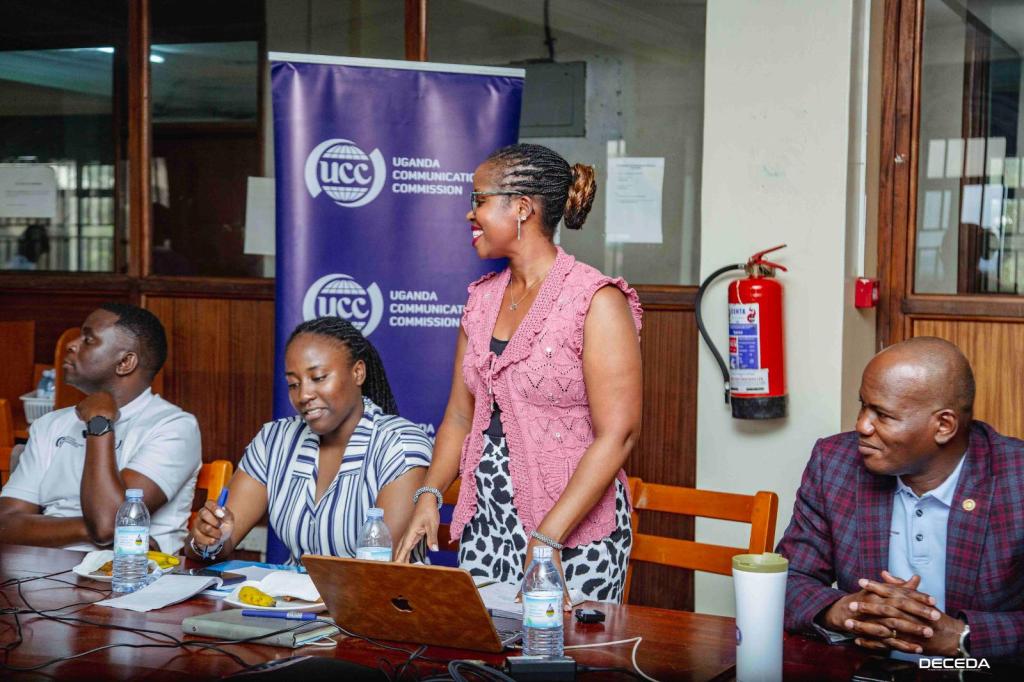
The Uganda Communications Universal Service and Access Fund, commonly known as UCUSAF, flagged off a team of Trainers of Trainees (ToTs) for the pilot project aimed at enhancing and advancing digital learning for primary schools in Uganda through a Digitally Enabled Community Development (ECD) Approach. The event was graced by the Vice Chancellor of Nkumba University, Prof. Jude Lubega, whereas UCUSAF was represented by UCC staff, Senior Officer Partnerships, Immaculate K. Amanya, and Patra Asiimwe, an intern.

This project resonates with Section 5 (s) of the Uganda Communications Act 2013 and the UCUSAF Strategy IV objectives 2 and 5 on increasing usage of digital devices and services by the underserved and unserved, as well as enhancing stakeholder collaboration for digital inclusivity.
Implemented in partnership with Nkumba University, the Digitally Enabled Community-centred Early-childhood Development Approach (DECEDA) will majorly leverage the existing community-based structures and systems coupled with digital technologies to deliver quality education services to underserved rural schools in Uganda. The project will also build on the previously developed Holistic E-Learning Platform (HELP). In order to foster this ICT pedagogy, the ToTs will empower at least 3 teachers from each school with equipment navigation and technical skills
Other objectives include:
- To enhance equitable access to quality education for all primary school learners in Uganda through integration of ICT in teaching and learning.
- To foster innovation and collaboration among schools through digital networking and content sharing.
- To improve learning outcomes by enhancing classroom instruction with multimedia and internet-based resources.
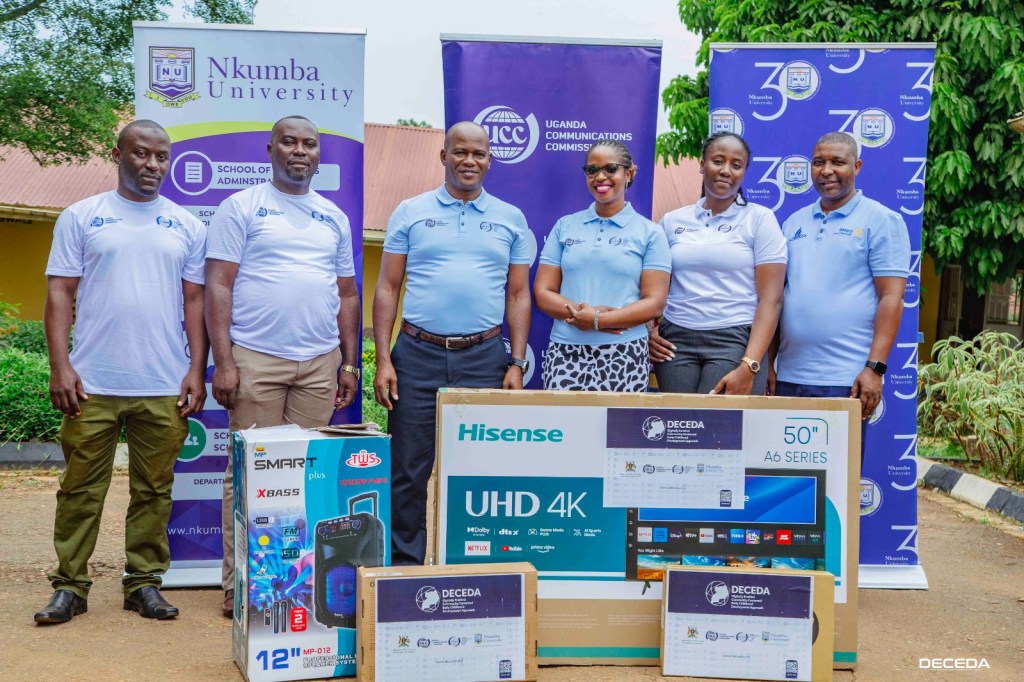
For this pilot phase, the project will be implemented in 31 primary schools across the country whose selection was technically informed by the Ministry of Education and Sports (MoE&S). Each school will receive a 50-inch television set, wireless speaker and a network router to support digital learning, whereas 6 of the 31 schools, also identified as “Anchor schools”, will in addition receive a laptop, and conference camera to enable the livestreaming of e-learning sessions to other schools.
Looking ahead, the DECEDA project is poised to serve as a model for ICT integration in Uganda’s primary education, with prospects of expanding the project to more schools nationwide, creating a central content hub for lesson materials and live-streamed sessions, and conducting a follow-up study to measure the impact on learning outcomes.
Apart from this intervention, the Uganda Communications Commission, through UCUSAF, has also supported over 1,417 government-aided secondary school and tertiary institutions across the country with computer laboratories. The Commission has also implemented a pilot E-Classroom project in selected primary schools in Buikwe, Nakasongola and Mpigi districts to promote access to knowledge, education and learning resources through digital solutions. This project is scheduled to be launched by September 2025.
The DECEDA project marks a significant step towards transforming Uganda’s education landscape. Through this strategic partnership with Nkumba University, the Commission is laying a durable foundation for the future where every learner, regardless of their location, has access to quality technology-enhanced education.


 THE COMMUNICATIONS BLOG
Leave a comment