


By Nyombi Thembo
The Uganda Communications Commission (UCC) has recently instituted a critical measure requiring artists and entertainment event organisers to obtain permits before staging live performances. This decision comes in response to growing public concerns surrounding the rise of vulgar and indecent content during live performances by both local and foreign artists in Uganda. Previous attempts at sensitisation and cautioning stakeholders have proven ineffective, necessitating this intervention.
Understandably, this action has ignited a debate regarding the UCC’s mandate, the necessity of these regulations, and how to strike an appropriate balance between maintaining public decency while ensuring fun and creativity within the entertainment industry. This article aims to clarify these three fundamental issues.

Regulation of Public Entertainment
The authority invoked to oversee public entertainment is rooted in the provisions of the Stage Plays and Performances Act Cap 49. While this law has a colonial origin, its relevance in protecting public decency in entertainment is arguably greater today than when it was introduced. The proliferation of artists and the diversity of entertainment sources throughout the country create logistical challenges for monitoring the entertainment landscape. However, advances in modern technology allow for the enforcement of regulatory standards, such as the issuance of entertainment permits, with minimal physical interaction.
Basis for Regulatory Oversight
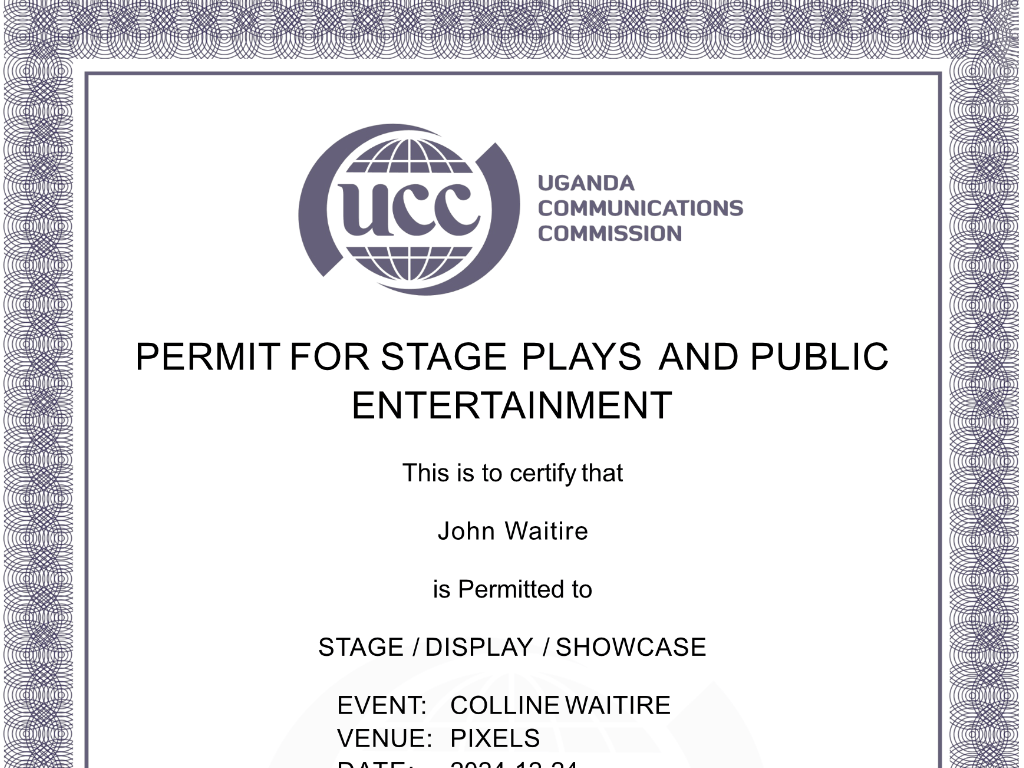
As outlined in the Uganda Communications Act of 2013, the Uganda Communications Commission is mandated to regulate communication services throughout the country, including content related to broadcasting and public entertainment. Under the Stage Plays and Public Entertainment Act Cap 49 and its associated regulations — specifically the Stage Plays and Public Entertainments Rules of 2019 — organisers and promoters of public events are required to seek authorisation from the UCC.
Section 4(1) clearly states: “No person shall present, cause, permit or suffer to be presented or shall take part or assist in any performance or presentation of any stage play or public entertainment to which the public shall be admitted, gratuitously or otherwise unless a permit (entertainment permit) in respect of the performance or presentation shall have previously been obtained from the Uganda Communications Commission.” Regulation 6(1) further reinforces this, indicating that staging or exhibiting a play or public entertainment without a permit is prohibited.
The law extends to cover advertising authorisation as well, stipulating that no advertisements for stage plays or public entertainment can be made without the Commission’s permission. This ensures that all broadcasters demand from their clients an entertainment permit before promoting any event.
Additionally, Section 49 of the Uganda Communications Act empowers the Commission to appoint inspectors to verify compliance with these provisions, while Clause 12 of the Stage Plays and Public Entertainments Rules authorises inspectors to access venues where public performances are ongoing. Therefore, staging any play or music concert in public without the requisite permit is considered an offense, attracting regulatory sanctions, including fines and potential prosecution.
Justification for Permits
In late 2024, a foreign musician performed at a concert in Kampala that left many attendees and viewers outraged. The performance involved a simulation of a sex act on stage, complete with props such as a bed and handcuffs. While some may have found this entertaining, many others deemed it grossly inappropriate. Such performances undermine public decency and the cultural values that are essential to our nation.
Furthermore, with the pervasive nature of media today, live performances can easily reach children, exposing them to content that is unsuitable for their age. The incident referenced above was not an isolated case, occurring shortly after UCC had to suspend several vulgar songs from the airwaves, reflecting a broader issue that requires urgent attention.
Accordingly, the need for a robust framework regulating public entertainment is clearer now than ever. UCC’s proactive approach in this regard aims to safeguard the integrity and decency of Uganda’s entertainment landscape while respecting the creative expressions of artists. As discussions around this policy continue, it is imperative to recognize the importance of balancing creativity and public decency in an increasingly complex media environment.
Striking a Regulatory Balance
As the regulator of the communications sector, the Uganda Communications Commission has a pivotal responsibility to maintain a healthy balance between public morality and the freedom of artists to express their creativity. This delicate balancing act requires a commitment to fairness and transparency, in which all stakeholders play a crucial role.
Artists and event organizers are encouraged to unleash their creativity while remaining sensitive to the feelings of the public. For instance, many local songs feature lyrics filled with sexual innuendo, yet they often don’t attract negative attention because they are presented in creative language that mitigates potential alarm.
UCC recognizes that our success in this endeavor relies heavily on the support of key stakeholders, including artists, event organizers, media houses, the general public, the police, and local government authorities. To strengthen this collaboration, we have partnered with the Uganda Police and other security agencies. They require proof of an entertainment permit issued by UCC before granting security clearance for any live performance.
To facilitate this process, we have developed a system that allows security agencies to easily verify the validity and authenticity of the entertainment permits presented to them using a QR code. This enhancement not only streamlines the verification process but also ensures compliance with established regulations.
Moreover, local governments, including the Kampala Capital City Authority (KCCA), will not issue clearance for live performance events within their jurisdictions without first confirming that the applicant possesses a valid entertainment permit issued by UCC.
To expedite and streamline the permit application process, UCC has incorporated the application into our e-Services portfolio. This innovative solution allows applicants to submit their applications from anywhere in Uganda and receive their permits online, a vital improvement that enhances convenience.
With a nominal fee of Shs 100,000, our goal is to make compliance as hassle-free as possible for all parties involved. Through these efforts, we aim to foster a dynamic environment where creativity flourishes, while respecting the values and sentiments of our diverse audience.
As we continue our work, we remain committed to ensuring that the communications sector in Uganda thrives in a balanced and responsible manner, where artistic expression and public morality coalesce harmoniously.
The author is Executive Director of Uganda Communications Commission.

 THE COMMUNICATIONS BLOG
Leave a comment