

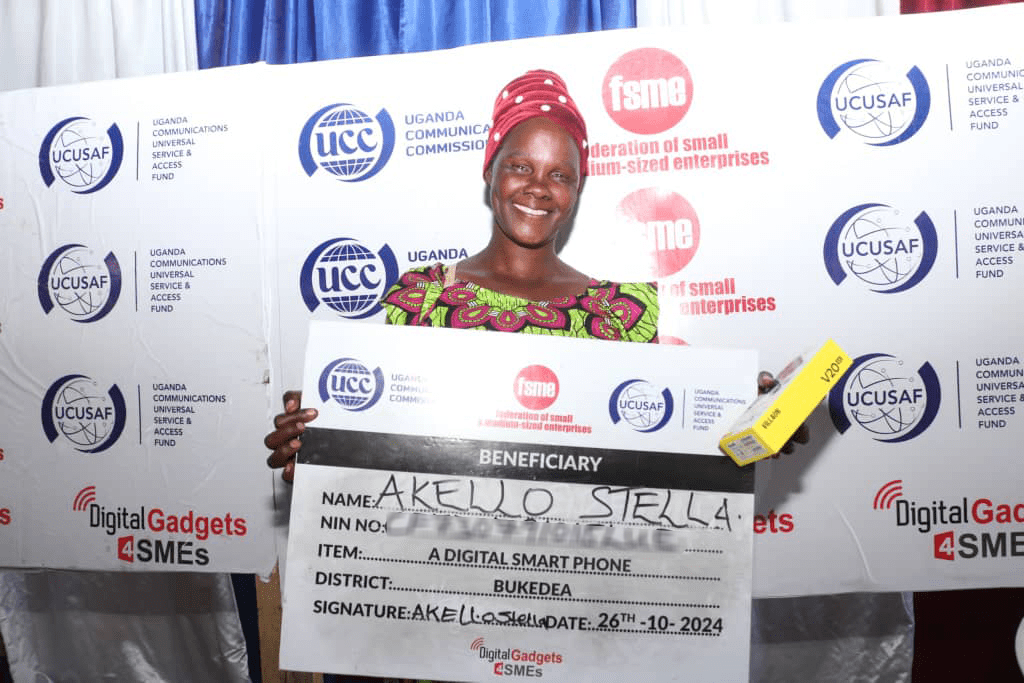
KAMPALA, October 30, 2024 – Since Uganda Communications Commission struck a partnership with the Federation of Small and Medium-Sized Enterprises-Uganda (FSMEU) in 2018 to conduct digital literacy training for its members, 9,077 MSMEs have been trained.
Through this partnership, which is implemented by the Uganda Communications Universal Service and Access Fund (UCUSAF), the two parties sought to empower the targeted MSMEs to harness the opportunities presented by ICTs to transform their businesses by improving their basic ICT skills and capabilities.
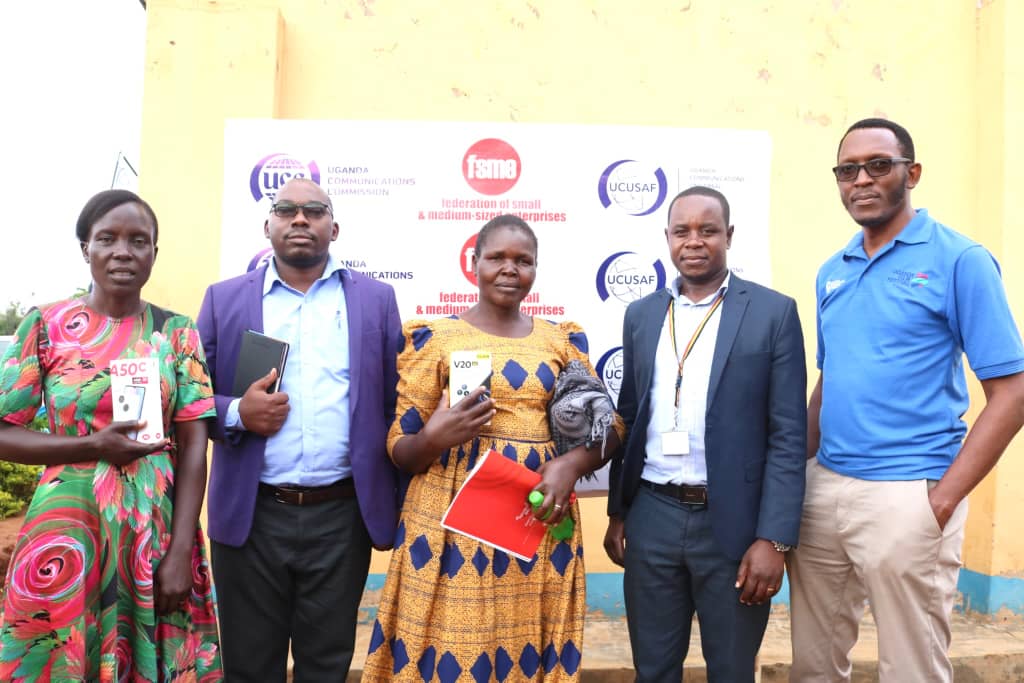
However, many beneficiaries raised the issue of lacking appropriate digital gadgets on account of their unaffordability, thus limiting the MSMEs’ ability to put into practice what they had learnt.
To address this quagmire, a study was conducted, and, among other findings, it was established that a relatively good smartphone costs upwards of Shs 500,000 on the Ugandan market, which is financially out of range for many members of FSMEU. It was further established that members were open to the idea of taking such gadgets on a loan basis.
Consequently, a digital device subsidy scheme for MSMEs was recently launched as a pilot project. Through this project, MSMEs that previously benefitted from the SME Digital Literacy and Skilling Campaign are eligible to receive a smart phone or tablet through a 50% partial loan or grant.
That means MSMEs will be expected to contribute 50% of the cost of the gadget. However, MSMEs without ready cash would also be able to borrow 50% of the cost of the gadget from a prequalified financial institution. The devices come installed with a range of digital tools that are customised to help the SMEs in book-keeping, marketing, and remote learning, among others.
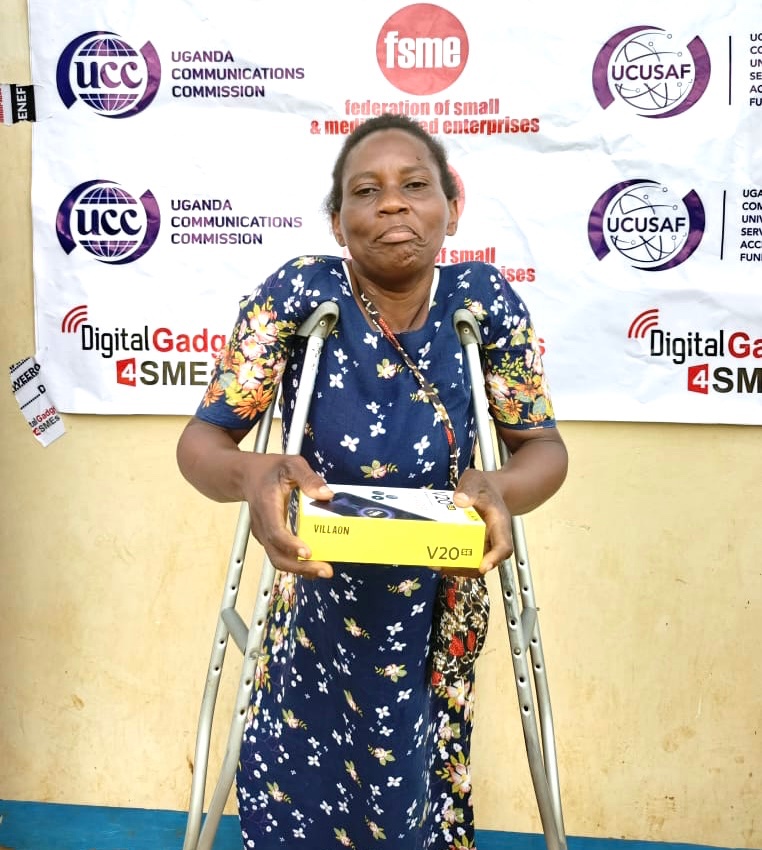
This digital device subsidy scheme seeks to bridge the digital divide that disadvantages many rural and urban poor SMEs who have undertaken digital literacy training but lack the resources to purchase the requisite digital devices. It is envisaged that the intervention will improve access to ICT gadgets, transform beneficiary MSME businesses and facilitate their active participation in the digital economy.
The Digital Literacy and Skilling Campaign was motivated by a 2015 study conducted by FSMEU, which found that only 9% of the 300 businesses interviewed had their contacts listed online. In addition, only 6% of the businesses had ever advertised online; only 22% admitted to having basic computer knowledge; only 14% said they were benefiting from their online engagement. More so, 73% acknowledged that digital illiteracy is hindering them from running their businesses effectively and that digitalizing their operations was important for their future growth.
Since 2018, some 23 training programs have been conducted for 9,077 MSMEs under the UCC-FSMEU partnership. The training sessions have been conducted in Kampala, Mbale, Mbarara, Gulu, Arua, Soroti, Jinja, Masaka, Lira, Hoima, Luwero, Bukedea, Iganga, Tororo, Kanungu, Moroto and Kasese. Skills bestowed on the trainees include tailoring, hairdressing, mechanics, metal fabrication and carpentry.
It is envisaged that the digital device subsidy scheme will augment this training program by providing devices to MSMEs that have the skills but lack the gadgets to put their skills to good use.
Beneficiary MSMEs must meet the following eligibility criteria:
• MSME that previously benefitted from digital literacy training
• MSME willing to take 50% of the cost of their gadget as a repayable loan.
• MSME willing to comply with the conditions of the lender, including interest rates, collateral or guarantee mechanisms.
• The digital gadget will be used primarily for business transactions.
To ensure that the scheme is working according to plan, FSMEU is required to hire a fiduciary agent (preferably an audit firm) to undertake Monitoring and Evaluation, on top of the internal M&E activities undertaken by FSMEU and UCC.
To ensure sustainability of the scheme, the recovered 50% of the cost of a digital device will be redeployed to benefit many more beneficiaries.
The project aims to distribute 1,000 gadgets within the first year.
The Federation of Small and Medium Enterprises-Uganda (FSME-U) is a not-for-profit membership association for Small and Medium Enterprises in Uganda. FSMEU was selected as the implementing partner of this project because of its competitive advantage, having trained the beneficiaries who are members of the umbrella organization.
Through UCUSAF, UCC undertakes interventions that seek to enhance connectivity and universal access of communications services in unserved and underserved areas of Uganda so as to bridge the digital divide, increase ICT uptake and usage, and boost social economic transformation.
This project, which is worth UGX 800M, is initially pencilled for one year, effective the date on which it was executed by the parties.


 THE COMMUNICATIONS BLOG
Leave a comment